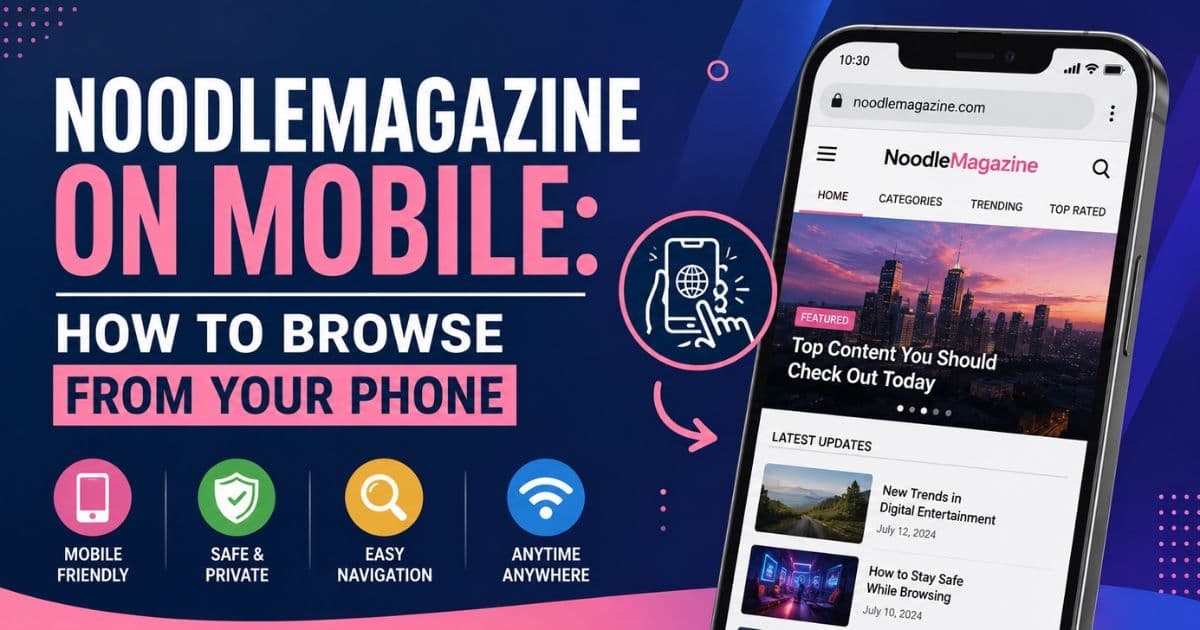


The internet has transformed the way people discover entertainment, lifestyle information, digital media, and online communities. Instead of depending only on traditional newspapers, television, or printed magazines, users can now explore a wide range of content through websites and digital platforms. NoodleMag is a search term that people may use when looking for an online magazine-style platform, digital content, or information associated with NoodleMagazine.
Modern online magazines are designed around convenience. Visitors can access content from a computer, tablet, or smartphone without needing a physical publication. This makes digital magazines an important part of today’s online media environment, particularly for people who prefer quick access to articles, images, entertainment-related material, and other forms of web content.
What Is NoodleMag?
The term noodlemag is commonly used as a shortened search phrase for NoodleMagazine or a website associated with that name. Like many abbreviated search queries, it may be used by people who already know the platform and simply want to find it quickly. Searchers may also use variations such as Noodle Mag website, NoodleMagazine, Noodle Magazine, or similar phrases.
Understanding search intent is important because a short keyword does not always represent a single question. One person searching for noodlemag may be trying to locate the website, while another may be looking for information about its content, browsing experience, privacy, or mobile accessibility. A useful online resource should therefore make navigation simple while providing clear information about what visitors can expect.
Why Do People Search for Noodle Mag?
Short brand-style keywords often receive searches from users who already have some familiarity with a website. They may have encountered the name through another website, a social media post, a recommendation, or a previous visit and want to return to it.
Some common reasons for searching include:
- Finding the official or current website
- Learning what type of content the platform provides
- Exploring recently published material
- Accessing the website from a mobile device
- Understanding privacy and browsing considerations
- Checking whether the website is easy to navigate
- Looking for specific categories or topics
Because search intent can vary, a comprehensive guide should address both basic discovery and the broader digital experience.
Understanding the NoodleMagazine Concept
The idea behind an online magazine is relatively simple: bring different types of digital content together in an organized web environment. Rather than distributing information through a physical publication, a digital magazine uses web pages, categories, images, navigation menus, and other online features to present information.
A platform such as NoodleMagazine can be viewed within this broader digital-media ecosystem. Visitors generally expect an online magazine to provide a straightforward way to move between pages and discover content. Page organization, readable layouts, responsive design, and clear navigation all contribute to how easily visitors can use a website.
Digital Magazines vs. Traditional Magazines
Traditional magazines depend on printed pages and physical distribution. Digital magazines operate through websites and internet-connected devices. This difference gives online publications several practical characteristics.
Digital platforms can offer:
- Faster publication and updating
- Worldwide accessibility
- Smartphone and tablet compatibility
- Search-engine discoverability
- Multimedia elements
- Links between related articles
- Easier navigation between categories
At the same time, digital publishing introduces considerations that do not always exist with printed material. Users should think about privacy, cookies, advertisements, external links, browser permissions, and the security of websites they visit.
Why NoodleMag Is Relevant to Online Search
Search behavior has changed considerably as internet users have become accustomed to using short phrases to find specific websites. Instead of typing a complete question, someone familiar with a brand may simply enter its name into Google or another search engine.
The keyword noodlemag fits this type of navigational search behavior. The user may not need a long explanation before visiting a website, but additional information can still be useful when they want to understand the platform or determine whether it meets their expectations.
Search engines also connect related queries with one another. Someone searching for noodlemag could potentially encounter variations such as:
- NoodleMagazine
- Noodle Magazine website
- Noodle Mag online
- Noodle Mag articles
- NoodleMagazine website
- Noodle Mag mobile
- Noodle Mag browsing guide
These related phrases represent semantic variations rather than completely separate topics.
The Importance of Search Intent
Search intent describes the reason behind a query. For an online magazine keyword, intent may be navigational, informational, or a combination of both.
For example, a navigational visitor may simply want to reach a particular website. An informational visitor may instead want to understand what NoodleMag is, how it works, or what type of content it offers.
Recognizing these different intents helps create better content because the page can answer multiple reasonable questions without repeatedly forcing the same keyword into every paragraph.
Exploring Content on an Online Magazine
One of the main advantages of a digital magazine is the ability to organize large amounts of information into categories. Visitors can move from one article to another using menus, internal links, category pages, search functions, and related-content recommendations.
A well-organized magazine website should make content discovery relatively straightforward. Instead of requiring users to manually browse through every page, useful navigation elements can help them find subjects that match their interests.
Common Features of Digital Magazine Websites
Although every website is different, online magazines often use several familiar features:
- Homepage content sections
- Category navigation
- Search functionality
- Featured articles
- Recent posts
- Related content
- Image galleries
- Mobile-responsive layouts
- Social sharing options
These features help turn a collection of individual web pages into a connected content platform.
Why Content Organization Matters
Good organization improves the overall user experience. When articles are grouped logically, visitors can understand the structure of a website without spending unnecessary time searching for information.
For SEO, organization is also useful because internal linking can help search engines understand relationships between pages. A central topic can be supported by related articles covering narrower subjects, creating a logical topical structure.
NoodleMag and Mobile Browsing
Smartphones have become one of the primary ways people access online content. Consequently, any modern digital magazine should be usable on smaller screens as well as desktop computers.
A responsive website automatically adapts its layout to different screen sizes. Text should remain readable, buttons should be easy to tap, and important navigation elements should not become difficult to access.
Tips for a Better Mobile Experience
Visitors can improve their browsing experience by keeping several basic practices in mind:
- Use an updated mobile browser.
- Keep the operating system reasonably current.
- Avoid opening suspicious pop-ups.
- Pay attention to unfamiliar redirects.
- Review browser permissions when necessary.
- Avoid entering sensitive information on unfamiliar pages.
- Use a reliable security solution on the device.
These practices are not specific to Noodle Mag. They are useful whenever someone browses an unfamiliar online platform.
Is NoodleMag Safe to Browse?
Website safety depends on the specific website, its current configuration, advertising networks, external links, and the behavior of individual visitors. Therefore, users should avoid assuming that a website is automatically safe or unsafe simply because of its name.
A sensible approach is to evaluate the website’s visible security characteristics and use normal internet-safety practices. Users should be particularly cautious when a page requests unnecessary personal information, attempts unexpected downloads, or redirects the browser repeatedly.
Basic Online Safety Practices
When visiting an unfamiliar website, users should consider the following:
- Check whether the connection uses HTTPS.
- Avoid downloading unknown files.
- Do not provide passwords unnecessarily.
- Be cautious with unexpected pop-ups.
- Do not install unknown browser extensions.
- Keep browser security features enabled.
- Verify external websites before entering personal information.
Users should also remember that HTTPS protects the connection between the browser and website but does not automatically mean that every piece of content or every external link on a website is trustworthy.
Privacy Considerations When Browsing NoodleMag
Privacy has become an important part of the modern web experience. Websites may use technologies such as cookies, analytics tools, advertising systems, and other tracking mechanisms to understand visitor behavior or provide functionality.
Before interacting extensively with any online magazine, visitors should consider reviewing its privacy policy and cookie information when available. These documents can explain what information may be collected, how it is used, and whether third-party services are involved.
Information Users Should Think About
Visitors should be careful about sharing:
- Full names
- Email addresses
- Telephone numbers
- Account passwords
- Payment information
- Precise location information
- Other personally identifiable information
In most cases, simply reading publicly available online content does not require users to provide sensitive personal information.
Cookies and Online Magazine Websites
Cookies are small pieces of data that websites can store in a user’s browser. They can serve different purposes, including remembering preferences, supporting website functionality, measuring traffic, or delivering advertising.
Not every cookie has the same purpose. Some are essential for website functionality, while others may be used for analytics or advertising.
Understanding cookie notices can help users make informed choices. If a website provides cookie settings, visitors can review the available options rather than automatically accepting every category.
NoodleMag and the Modern Digital Media Experience
The online publishing environment has changed significantly. Readers increasingly expect websites to load quickly, work on mobile devices, and make information easy to discover.
This means an online magazine is no longer simply a collection of articles. The overall experience can include navigation, performance, responsive design, search functionality, multimedia, social features, and privacy controls.
What Makes Digital Content Convenient?
Digital content offers several practical advantages:
- Immediate access
- No physical storage required
- Easy searchability
- Cross-device access
- Frequent updates
- Internal linking
- Multimedia support
These characteristics explain why online magazines remain relevant even as traditional publishing continues to evolve.
How to Find Relevant Content on NoodleMag?
Visitors who arrive at an online magazine for the first time may benefit from using the website’s navigation rather than randomly opening pages. Start with the homepage and identify available categories or sections.
If a search box is available, using specific terms can make content discovery faster. Related articles can also be useful because they may lead to pages covering similar subjects.
A Simple Content-Discovery Process
A practical approach is:
- Start at the homepage.
- Review the main navigation menu.
- Identify categories related to your interest.
- Use the internal search feature if available.
- Open relevant articles.
- Follow useful internal links.
- Return to category pages for additional content.
This approach works across many types of online magazines and content websites.
Noodle Mag on Different Devices
A modern web platform should ideally provide a consistent experience across desktops, laptops, tablets, and smartphones. However, the exact appearance can vary depending on the browser, operating system, screen resolution, and connection speed.
Desktop users typically have more screen space, while mobile visitors benefit from simplified menus and responsive layouts. Tablets sit somewhere between these experiences.
Improving the Browsing Experience
Regardless of the device being used, visitors can improve performance by:
- Closing unnecessary browser tabs
- Keeping the browser updated
- Clearing outdated cached data when needed
- Using a stable internet connection
- Avoiding suspicious browser extensions
- Keeping device security software updated
These simple steps can reduce common browsing problems.
SEO and NoodleMag Search Queries
From an SEO perspective, noodlemag represents a highly specific keyword that can be supported by semantically related phrases. Search engines increasingly rely on context rather than exact keyword repetition alone.
A page targeting this topic can naturally include related terms such as NoodleMagazine, online magazine, digital content, web magazine, online articles, mobile browsing, website navigation, privacy, and internet safety.
Semantic Keywords Related to NoodleMag
Relevant LSI-style and semantic terms include:
- NoodleMagazine
- Noodle Mag website
- Noodle Magazine
- online magazine
- digital magazine
- online content
- digital media
- web articles
- magazine website
- content discovery
- mobile browsing
- website navigation
- online privacy
- browser security
- digital publishing
These phrases should be used naturally according to the context rather than inserted repeatedly for the sake of SEO.
Why Natural Keyword Usage Matters?
Keyword stuffing can make an article difficult to read and may create a poor experience for visitors. Modern SEO works better when content clearly satisfies the user’s underlying search intent.
Instead of repeating “noodlemag” in every paragraph, a strong article can mention the main phrase where it is relevant and use variations elsewhere. This creates a natural semantic relationship between the primary keyword and supporting concepts.
For example, an article can discuss NoodleMagazine in one section, digital publishing in another, mobile browsing in another, and privacy considerations in another. Together, these subjects provide broader topical coverage.
The Future of Online Magazines
Digital publishing is likely to continue evolving as internet users increasingly consume information through smartphones and other connected devices. Websites may incorporate faster interfaces, richer multimedia, improved personalization, and more sophisticated content discovery tools.
At the same time, privacy and security will remain important. Users are becoming more aware of tracking, cookies, data collection, and online safety, while publishers need to balance functionality with responsible digital practices.
What Readers Can Expect
Future digital magazine experiences may place greater emphasis on:
- Mobile-first design
- Faster page performance
- Personalized recommendations
- Multimedia storytelling
- Better search functionality
- Accessibility
- Transparent privacy practices
- Improved content organization
These developments can make online publishing more convenient while giving readers greater control over how they interact with digital content.
Final Thoughts
NoodleMag is a concise search phrase associated with NoodleMagazine and the broader idea of accessing magazine-style content online. For visitors, the most important factors are straightforward navigation, useful content, mobile compatibility, privacy awareness, and responsible browsing habits.
As digital publishing continues to grow, online magazines will remain an accessible way to discover articles and other forms of web content. Whether someone arrives through a search engine, a direct website visit, or an external link, understanding basic browsing and privacy practices can make the experience more informed.
For website owners and content creators, the same principles apply from an SEO perspective. A useful page should satisfy search intent, provide meaningful information, use related terminology naturally, and clearly connect supporting topics. Rather than focusing exclusively on repeating the phrase noodlemag, comprehensive topical coverage provides a stronger foundation for a useful and search-friendly article.
RELATED POST: NoodleMagazine on Mobile