
The internet is full of websites that attract attention through distinctive names, simple layouts, and easy-to-remember branding. Noodle Magazine is one such search term that people encounter while looking for information about an online platform, its content, features, accessibility, and safety. Understanding what the name refers to is an important first step before visiting a website or interacting with its content.
This guide explores Noodle Magazine, including its general purpose, browsing experience, website accessibility, privacy considerations, security precautions, and possible alternatives. Because different websites may use similar names or domain variations, it is important to distinguish between a brand name, a search term, and a specific website. The following information helps readers evaluate online platforms carefully rather than assuming every website using a similar name offers the same services.
What Is Noodle Magazine?
Noodle Magazine is a name associated with different online websites and content-related platforms. Depending on the particular domain, the name may refer to an online magazine, a digital publishing service, or a website associated with video content. Consequently, visitors should identify the exact website before deciding what it offers.
People searching for Noodle Magazine may have different intentions. Some want to understand the platform, while others are interested in its content, website functionality, mobile compatibility, or online safety. Understanding these differences helps visitors find relevant information and avoid confusion between similarly named websites.
Understanding the Noodle Magazine Name
A website’s name does not always explain its purpose. Words such as magazine, media, and digital content can describe several types of online services, from traditional editorial publications to multimedia websites.
Before using a website associated with this name, consider the following points:
- Website identity: Check the complete domain name rather than relying on the brand name alone.
- Content type: Review the homepage and available information to understand what the platform provides.
- Ownership information: Look for an About Us page, contact details, and other identifying information.
- Privacy information: Read the privacy policy to understand how personal information may be handled.
- Website consistency: Make sure the pages, branding, and policies appear consistent with the domain you intended to visit.
These simple checks can help users distinguish between legitimate services and unrelated websites using similar branding.
Why Do People Search for Noodle Magazine?
Search interest can develop for several reasons. A website may attract attention through online discussions, recommendations, search engine results, or curiosity about its name. People may also search for spelling variations when they cannot remember the exact domain.
Related searches can include Noodle Magazine website, NoodleMagazine online, Noodle Magazine guide, NoodleMagazine safety, and Noodle Magazine alternatives. These queries represent different information needs, so a useful guide should address the broader topic rather than repeat the same keyword throughout the page.
How Does Noodle Magazine Work?
The way Noodle Magazine works depends on which website a visitor means. Online publishing websites generally organize material into categories, articles, issues, or other content sections. Multimedia platforms may instead organize material around videos, search functions, tags, or content categories.
Visitors should not assume that every website associated with the Noodle Magazine name has identical features. The available services, registration requirements, content restrictions, and browsing options can vary between domains. Checking the actual website is therefore more reliable than depending on descriptions published elsewhere.
Understanding Website Navigation
Website navigation helps visitors locate information without moving randomly between pages. A well-organized website typically uses menus, category links, search tools, and descriptive page titles to make content easier to discover.
When exploring a website, look for these common elements:
- Homepage: Provides an overview of the website and its main sections.
- Navigation menu: Helps visitors move between categories and important pages.
- Search functionality: May allow users to find specific articles or other content.
- About page: Explains the website’s purpose and background.
- Contact page: Provides a way to ask questions or report problems.
- Privacy policy: Describes relevant information-handling practices.
Not every platform offers all these features. Their presence, clarity, and accuracy can nevertheless help visitors assess how thoughtfully a website is managed.
Does Noodle Magazine Require Registration?
Registration requirements depend on the specific website and the service being accessed. Some online platforms make certain content available without an account, while others require registration for subscriptions, personalized features, or restricted sections.
Before creating an account, check whether registration is necessary and what information is requested. Be cautious if a website asks for unnecessary personal details, payment information without a clear explanation, or credentials belonging to another service.
A registration form should clearly explain the purpose of collecting information. If the website’s identity or policies are unclear, avoid sharing personal details until you can establish whether the service is trustworthy.
Noodle Magazine Features and Browsing Experience
Features influence how easily visitors can understand and navigate a website. Depending on the platform, relevant elements may include category navigation, search tools, responsive page layouts, content descriptions, and accessibility options.
However, features should be verified on the specific domain. A general article should not promise particular functions, video quality, account options, or subscription services without reliable evidence that the website actually provides them.
Website Design and User Experience
A clear website design helps visitors understand where they are and what they can do next. Good navigation, readable text, consistent spacing, and descriptive links can make browsing easier for people using desktop computers, tablets, and smartphones.
A website’s appearance alone does not prove that it is reliable. A professional-looking homepage can still have unclear ownership information or inadequate privacy explanations. Similarly, a basic design is not automatically evidence of a problem.
When evaluating the browsing experience, consider:
- Whether navigation labels are clear and understandable.
- Whether important policies are easy to locate.
- Whether pages load without repeated redirects.
- Whether buttons behave as expected.
- Whether unexpected advertisements interrupt normal browsing.
- Whether the website explains its content and services accurately.
These observations provide a more useful assessment than judging a platform solely by its visual appearance.
Search and Content Discovery
Search tools and category pages can make large websites easier to navigate. On a publishing platform, categories might organize articles by subject, while a multimedia platform may use tags or other classification methods.
When a website provides search functionality, use specific terms instead of broad queries. Descriptive keywords can help narrow results and reduce the time spent navigating unrelated pages.
Visitors should also remember that search results do not necessarily indicate editorial quality, ownership, licensing, or accuracy. A page appearing prominently within a website is not automatically trustworthy simply because it is easy to find.
Is Noodle Magazine Safe to Use?
The safety of Noodle Magazine cannot be determined from the name alone. Different websites using similar names may have different owners, security practices, advertising arrangements, and content policies. A reliable assessment therefore requires examining the exact domain and its current behavior.
Online safety involves more than whether a page opens successfully. Visitors should consider privacy, potentially deceptive advertisements, unwanted downloads, suspicious redirects, payment requests, and the transparency of the website’s operators.
Potential Online Risks
Some unfamiliar websites may display aggressive advertising, open unexpected tabs, or redirect visitors to unrelated pages. Others may request personal information without clearly explaining why it is needed. These behaviors deserve caution, although their presence should be assessed on the specific website rather than assumed from its name.
Common warning signs include:
- Repeated redirects to unfamiliar domains.
- Download prompts that appear without a clear reason.
- Fake security warnings claiming that a device is infected.
- Requests to install unknown browser extensions.
- Forms asking for passwords or payment details unnecessarily.
- Missing or contradictory information about the website’s operator.
- Messages pressuring visitors to act immediately.
If any of these signs appear, close the suspicious page and avoid interacting with its prompts. Do not install software or provide sensitive information simply because a pop-up claims it is required.
How to Evaluate Website Trustworthiness?
A practical safety check combines several sources of information. Start by examining the domain carefully, then review the website’s policies and ownership details. You can also use reputable security services to check whether a domain has been reported for phishing, malware, or other suspicious activity.
Remember that a clean security scan is not a guarantee of safety. New websites, recently introduced threats, and deceptive behavior may not appear in every database. HTTPS encryption is useful because it protects information in transit, but it does not prove that a website is honest or that all its content is legitimate.
The safest approach is to combine technical checks with common sense. If the domain, ownership, requested permissions, or behavior appears suspicious, do not proceed until the concerns are resolved.
Noodle Magazine Privacy and Data Protection
Privacy is an important consideration whenever someone visits an unfamiliar website. Depending on its technology and configuration, a website may process information such as IP addresses, browser details, cookies, usage data, or information voluntarily submitted through forms.
The exact information collected by a particular Noodle Magazine website cannot be established without reviewing its applicable privacy policy and practices. Visitors should avoid assuming that a platform collects no data simply because it allows browsing without registration.
What Information Can Websites Collect?
Websites can collect different categories of information depending on their purpose and technical setup. Some data may be provided directly by visitors, while other information may be generated automatically during normal browsing.
Examples include:
- Technical information: Browser type, operating system, and device characteristics.
- Connection information: IP address and related server logs.
- Cookie data: Preferences, session identifiers, or analytics information.
- Account information: Details submitted when creating an account, where applicable.
- Communication details: Information included in messages sent through contact forms.
These examples describe common website practices, not confirmed collection practices for every website using the Noodle Magazine name. The relevant privacy notice should explain what actually applies.
Ways to Protect Your Privacy
You can reduce unnecessary exposure by limiting the information you share and reviewing your browser settings. Use unique passwords for different services, enable multifactor authentication when available, and avoid submitting sensitive information to websites whose operators you cannot identify.
Additional precautions include:
- Review cookie and tracking preferences where available.
- Keep your browser and operating system updated.
- Avoid signing in through links received from unknown sources.
- Use a separate, unique password for each account.
- Review permissions before installing extensions or applications.
- Close sessions on shared computers when you finish browsing.
Private browsing modes can reduce some local traces, such as browsing history saved by the browser, but they do not make users completely anonymous. Websites, internet providers, employers, and network administrators may still have visibility into certain activity depending on the circumstances.
Can You Access Noodle Magazine on Mobile Devices?
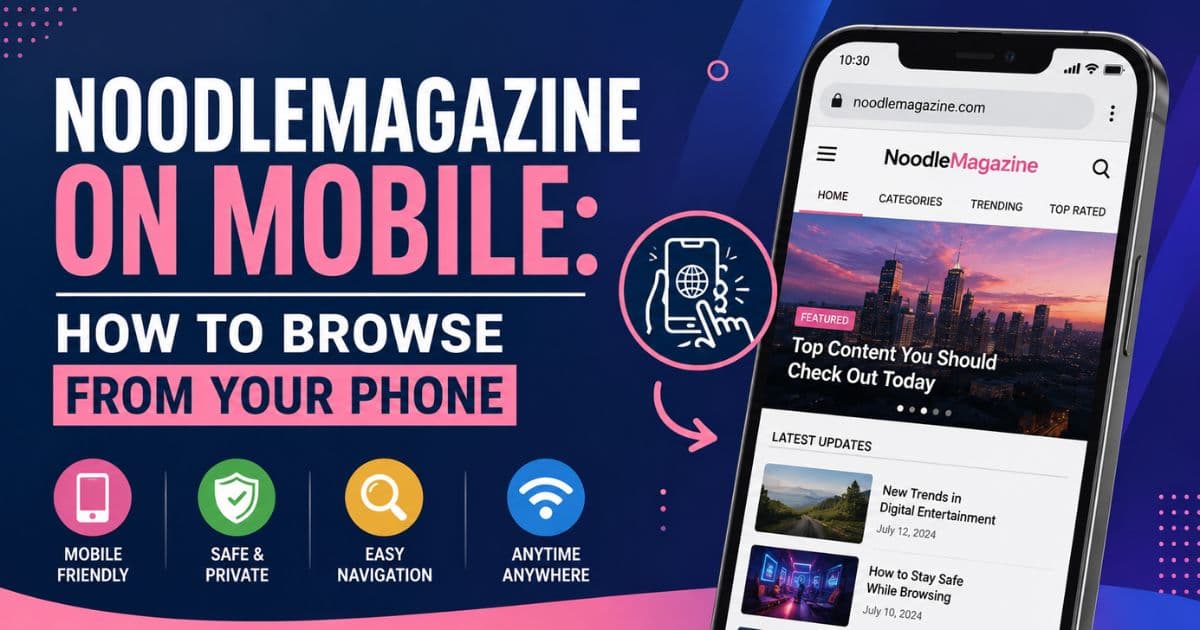
Many modern websites can be opened through mobile browsers, but compatibility depends on the particular domain, its design, and the content it serves. A website that displays correctly on a desktop computer may still have navigation, readability, or performance problems on a smaller screen.
Before using an unfamiliar website on a smartphone, check whether the page layout adapts properly and whether links and controls work as expected. You generally do not need to install an additional application merely to test a website that is available through a browser.
Mobile Browsing Tips
A few basic practices can make mobile browsing more convenient and secure. Keep your browser updated, use the official application store if an application is genuinely required, and avoid downloading installation files from unfamiliar websites.
Consider these additional tips:
- Use a secure internet connection when submitting sensitive information.
- Avoid granting unnecessary notification permissions.
- Close tabs that repeatedly open unwanted advertisements.
- Check the domain before entering information into a form.
- Keep your device’s built-in security protections enabled.
- Avoid installing files prompted by unexpected messages.
If a page behaves differently on mobile, try refreshing it or checking the browser’s compatibility settings. Do not disable essential security protections simply to make a questionable website work.
Noodle Magazine Alternatives: What Should You Consider?
People searching for Noodle Magazine may be looking for different kinds of online content. Some may want editorial articles, while others may be interested in digital publications or multimedia websites. Choosing an alternative begins with identifying the type of content and experience you actually want.
Rather than selecting a website solely because its name resembles another platform, compare its purpose, transparency, content quality, privacy practices, and available features.
Choosing a Suitable Alternative
For general reading, look for established publishers with clear editorial standards and identifiable authors. If you want digital magazines, consider services that explain their publication catalogue, subscription terms, and cancellation policies. For educational or entertainment content, prioritize services that provide clear ownership information and transparent content rules.
A useful comparison checklist includes:
- Content relevance: Does the service provide the material you want?
- Credibility: Can you identify the publisher or operator?
- Privacy: Is there a clear explanation of data handling?
- Security: Does the service avoid suspicious redirects and downloads?
- Accessibility: Does it work well on your preferred device?
- Cost: Are subscriptions, purchases, and renewals explained clearly?
- Content rights: Is there information about licensing and creator permissions?
Comparing these factors helps you make an informed decision instead of relying on promotional claims or search rankings alone.
Why Domain Verification Matters
Similar names can belong to unrelated websites. A domain may differ by a single letter, an added word, or a different extension, yet lead to a completely separate service. This can create confusion when searching for a particular brand.
Before following a link, inspect the full web address and compare it with the domain identified by a reliable source. Do not assume that a website is official merely because it uses a familiar name, logo, or color scheme.
Common Problems When Visiting Noodle Magazine
Visitors sometimes encounter pages that load slowly, display errors, or behave differently across browsers. Such problems can result from a temporary network issue, a server outage, browser settings, an outdated browser, or changes made by the website operator.
A loading problem does not automatically mean that a website has been blocked or permanently discontinued. Similarly, repeated redirects or unexpected downloads should not be treated as ordinary technical errors without further investigation.
Website Not Loading
If a website does not load, first check that the domain has been entered correctly. A small spelling error can send a visitor to an unrelated destination or produce a browser error.
You can then try refreshing the page, checking your internet connection, or opening the website in an updated browser. If the problem continues, wait and try again later rather than repeatedly following unfamiliar links claiming to provide an alternative address.
Slow Loading and Browser Errors
Slow performance can be caused by a weak connection, a busy server, large media files, or browser-related issues. Try loading another reputable website to determine whether the problem is specific to one domain.
If only the unfamiliar website behaves strangely, avoid installing recommended repair tools or software from its pop-ups. Browser errors should be addressed through trusted device settings and official support resources, not through unsolicited downloads.
Understanding Responsible and Legal Online Browsing
Responsible browsing includes respecting privacy, content ownership, age restrictions, and applicable laws. The legal status of a particular website depends on its content, licensing arrangements, operations, and the laws relevant to the visitor.
A website’s accessibility does not establish that every item it hosts or links to is authorized. Visitors should consider whether content is published with appropriate permission and whether the platform provides information about its moderation and reporting processes.
Copyright and Content Permissions
Copyright protects many forms of creative work, including writing, photography, illustrations, music, and video. The rules governing access, copying, downloading, and redistribution vary by jurisdiction and circumstance.
Before copying or republishing online material, check the applicable license and obtain permission when required. If a website provides a reporting process for copyright or consent concerns, review the procedure and submit accurate information when appropriate.
Age Restrictions and Personal Responsibility
Some online platforms contain material intended only for adults. Users should follow applicable age restrictions, platform rules, and local laws. Parents and guardians can also use appropriate device-level controls and age-appropriate browsing settings to help protect younger users.
Never assume that a website’s lack of an age-verification screen means its content is suitable for everyone. If a page displays material that you did not intend to access, leave it and avoid interacting with suspicious advertisements or prompts.
Final Thoughts on Noodle Magazine
Noodle Magazine is a term that requires context because similar names may identify different websites and services. Understanding the exact domain is essential before making assumptions about its purpose, features, availability, or reliability.
A careful approach to online browsing includes checking website ownership, reading privacy policies, avoiding suspicious downloads, and limiting the personal information you share. These practices are useful whether you are exploring a digital publication, an online content platform, or another unfamiliar service.
Ultimately, the best way to evaluate Noodle Magazine is to combine accurate information about the particular website with sensible privacy and security precautions. By verifying the domain, checking available evidence, and understanding the risks associated with unfamiliar online services, readers can make better-informed decisions about their browsing experience.
RELATED POST: Noodlemagazin Complete Guide to the Platform